Does the 2027 Volvo EX60 have 800V charging?
Yes. The 2027 EX60 uses 800V architecture on both the Plus and Ultra trims. It also includes a 400V DC/DC booster so it can accept charges from the more common 400V public DC fast chargers.

The 2027 Volvo EX60 uses 800V electrical architecture, a specification that separates it from most rivals still running 400V systems. That platform enables faster charging, more efficient power delivery, and bi-directional energy flow across both trims. This page breaks down every performance-related spec and feature, check available inventory at Volvo Cars Savannah.
The headline performance story on the 2027 EX60 is the 800V electrical architecture. Most mainstream EVs today operate on 400V systems. Moving to 800V means lower current draw for the same power output, which reduces heat, cuts energy loss through the cables and motor windings, and allows the onboard charger to run at 19.2 kW on AC. That 19.2 kW onboard charger (OBC) is not a premium add-on, it is standard on both the Plus and Ultra trims.
Bi-directional charging is also standard across the lineup. The EX60 can send power back out to a home, a device, or another vehicle, turning the battery into a usable energy source rather than just a destination for grid power.
The shift-by-wire single-speed transmission rounds out the core drivetrain. There is no mechanical linkage between the driver and the gearbox. The driver's input is a signal, and the transmission responds instantly, removing the lag and mechanical slop that older drive-by-wire systems sometimes introduced.
The 800V architecture works by doubling the voltage compared to a standard EV platform. Higher voltage at the same wattage means half the current flows through the system. Lower current means less heat in the battery, cables, and motor. Less heat means the system can sustain peak output longer before thermal throttling kicks in.
The 400V DC/DC booster is part of that story. Public DC fast chargers are mostly built for 400V vehicles. The EX60 includes a DC/DC booster that steps the charger's 400V output up to the car's native 800V, so you are not limited to 800V-native charging stations. The EX60 accepts both.
The active chassis paired with FSD (Frequency Selective Damping) dampers adds a mechanical layer to the performance picture. FSD dampers change their response rate based on the frequency of the road input. Low-frequency, large-amplitude inputs like speed bumps get a softer response. High-frequency, small-amplitude inputs like road texture get a firmer response. The result is a chassis that stays composed without trading ride comfort for handling.
Pilot Assist, one-pedal drive, and drive modes (including a Performance mode) tie the electronics into the driving experience. One-pedal drive lets the regenerative braking do most of the deceleration work, recovering energy on every lift of the throttle. Drive modes shift throttle mapping, chassis response, and steering weight. The Performance drive mode sharpens all three simultaneously.
Both the Plus and the Ultra receive the full performance package without exception. There is no entry-level trim that strips out the 800V architecture or the 19.2 kW OBC.
The Ultra adds the Bowers & Wilkins Premium Sound system over the Plus trim's Bose Premium system, and swaps in 22-inch wheels over the Plus trim's 20-inch units. Larger wheels affect unsprung mass and can tighten steering response. Neither change touches the core drivetrain or charging spec.
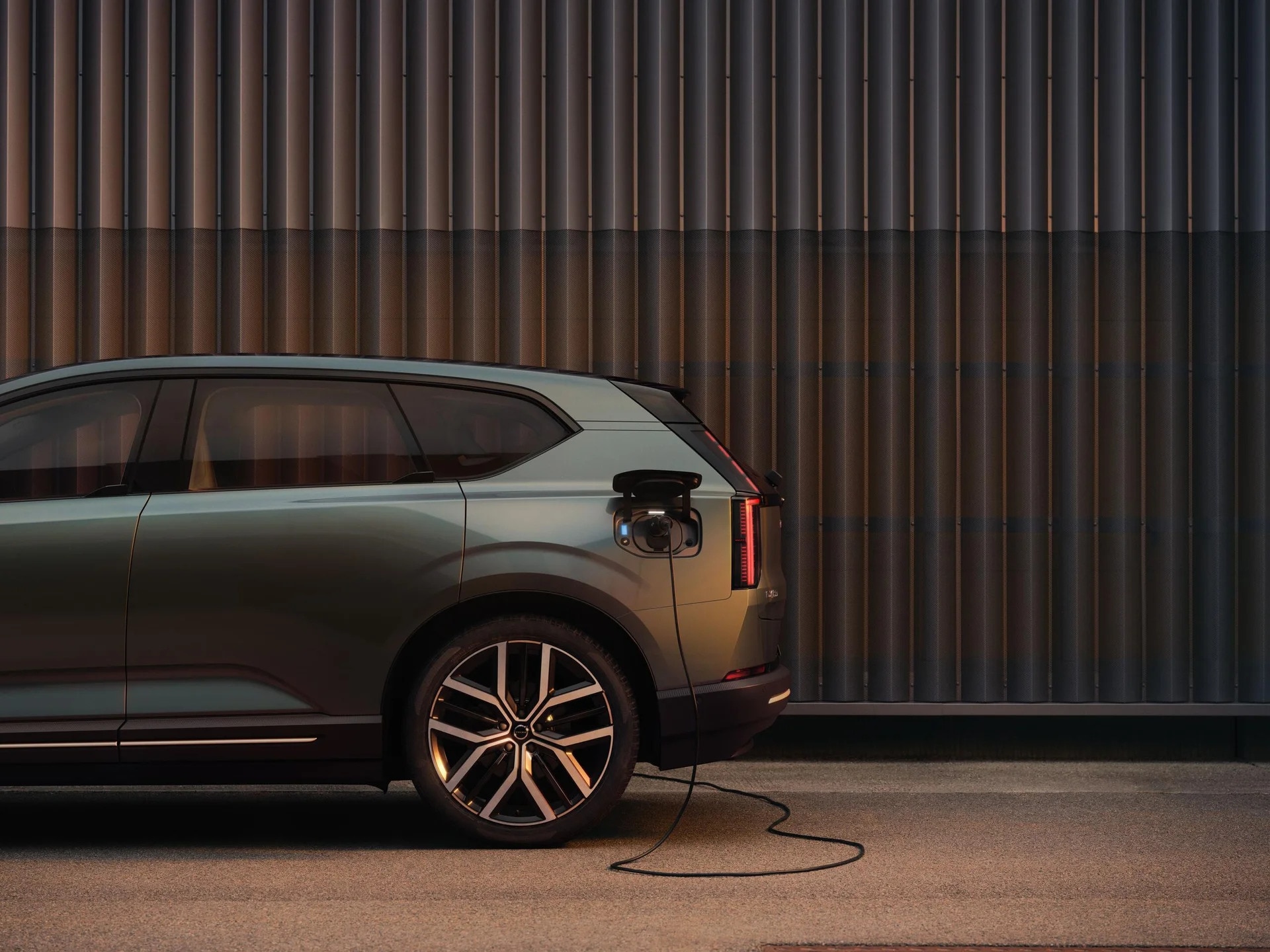
Savannah's climate is a real variable for EV ownership. High humidity and summer heat put sustained load on battery thermal management. The 800V platform's lower current draw reduces heat generation at the source, which means the cooling system works less aggressively during a hot afternoon charge on a Level 2 station.
The 19.2 kW OBC matters at home more than it might appear. A typical Level 2 home charger delivers 7.2 kW to a 7.2 kW OBC. Installing a 19.2 kW-capable home charger, which is increasingly common, means the EX60 can accept nearly three times the charge rate overnight. A driver who plugs in at 10 PM in Savannah and unplugs at 6 AM has eight hours of high-rate charging available.
Bi-directional charging turns the EX60 into backup power for a home or garage during the tropical storm season that Savannah residents plan for every summer. That is not a marketing feature here, it is genuinely useful.
The hands-free power tailgate (standard on Plus and Ultra) and the 18.5 cu. ft. of cargo space behind the second row (64.3 cu. ft. with both rows folded) support the practical side of the EX60's performance mission. The frunk adds 2.1 cu. ft. of separate, lockable storage. Range assistant software helps drivers plan charging stops on longer routes north toward Hilton Head, Charleston, or Atlanta.
U.S. Department of Energy on 800V EV charging infrastructure
The 800V architecture puts the EX60 in the same technical tier as the Hyundai IONIQ 6, Kia EV6, and Porsche Taycan, vehicles that all use 800V platforms for their fast-charging advantage. Most competitors in the EX60's size class, including several German and domestic midsize electric SUVs, still run 400V systems and require higher current to deliver comparable charge rates.
The 19.2 kW AC onboard charger is toward the top of what any production EV offers today. Many competitors cap AC charging at 11.5 kW or 7.4 kW, which limits how much benefit a high-output home charger actually provides.
Bi-directional charging is not yet standard across the segment. Several competitors offer it as an optional add-on or restrict it to specific market configurations. The EX60 includes it on every unit sold.
The active chassis with FSD dampers is a hardware differentiator. Competing systems often use passive dampers even in premium trims, reserving adaptive hardware for top-spec or sport-oriented packages.
The 2027 EX60 delivers an 800V platform, 19.2 kW charging, and bi-directional capability as standard equipment on every unit. Savannah drivers who want to see how the active chassis and Performance drive mode feel on local roads can schedule a drive at Volvo Cars Savannah. The team is ready to walk through every spec in person.
Yes. The 2027 EX60 uses 800V architecture on both the Plus and Ultra trims. It also includes a 400V DC/DC booster so it can accept charges from the more common 400V public DC fast chargers.
The 2027 EX60 comes with a 19.2 kW onboard charger on both trims. That rating determines how fast the vehicle accepts AC power from a Level 2 home or public charger.
Yes. Bi-directional charging is standard on both the Plus and Ultra. The vehicle can send power back to a home or external load, not just receive it.
Plug & Charge is a protocol that authenticates the vehicle automatically when the charge cable is connected, without needing an app or RFID card. It is standard on both EX60 trims.
The EX60 includes standard drive modes plus a Performance drive mode on both trims. Performance mode sharpens throttle response, chassis behavior, and steering character simultaneously.
Behind the second row, the EX60 offers 18.5 cu. ft. of cargo space. With both rows folded, that expands to 64.3 cu. ft. The frunk adds 2.1 cu. ft. of separate storage up front.
Yes. One-pedal drive is standard on both Plus and Ultra trims, using regenerative braking to decelerate the vehicle and recover energy when the driver lifts off the throttle.